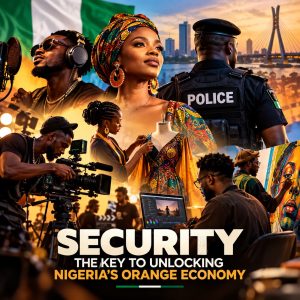
Nigeria’s creative economy has grown far beyond entertainment. Music, film, fashion, publishing, photography, digital content, advertising, art and other creative enterprises now represent significant economic activities, creating jobs, attracting investment and giving young Nigerians opportunities to turn talent into businesses.
As the sector grows, one issue deserves greater attention: security.
The issue came into focus during a recent conversation on African Independent Television (AIT), where Lanre Olagunju, Special Adviser on Media and Strategy to the Inspector-General of Police, spoke about the relationship between security and the country’s Orange Economy. His comments point to a wider reality: if Nigeria wants to unlock the full economic potential of its creative sector, it must also create an environment where the people, businesses, investments and intellectual property within that sector can operate with confidence.
The Orange Economy Is an Economy
For years, conversations around Nigeria’s creative industry have often focused on its cultural influence. We celebrate Nigerian music crossing borders, films reaching international audiences, fashion gaining global attention and digital creators building huge followings.
But behind every creative product is an economic ecosystem.
A film involves producers, actors, technicians, transporters, equipment providers and other businesses. A concert involves performers, event organisers, security personnel, vendors and service providers. A fashion brand involves designers, manufacturers, marketers and retailers. Even a content creator may be running a business with employees, equipment, clients and intellectual property.
Once creativity is understood in these terms, security can no longer be treated as an issue separate from economic development.
Security Is Part of the Infrastructure
Economic infrastructure is usually associated with roads, electricity, transportation, technology and finance. But businesses also need security to operate effectively.
A film crew needs to be able to work safely at a location. An entertainment company organising an event needs confidence that performers, workers and audiences can be protected. Creative businesses need to safeguard equipment, premises and other assets. Entrepreneurs investing in the sector need confidence that their investments will not be undermined by criminal activity.
This is where the Nigeria Police Force has an important role to play.
The responsibility is not to regulate creativity or determine what the industry should produce. There are specialised institutions responsible for copyright and other regulatory matters. The Police role is fundamentally about protecting people, businesses and legitimate economic activity from crime and other security threats.
A more deliberate partnership between the Police and the creative sector could therefore help build the confidence necessary for the industry to grow.
Nigeria’s Greatest Creative Resource Is Its People
Perhaps the most important part of this conversation is the young Nigerians driving the creative economy.
Across the country, young people are turning skills and ideas into businesses. A camera can become a production company. A laptop can become a design studio. A smartphone can become a media platform. A creative skill can become a source of employment not only for its owner but eventually for others.
This entrepreneurial energy is an economic asset.
But talent needs an enabling environment. Young entrepreneurs need access to finance, technology, infrastructure, markets and skills. They also need to feel reasonably secure as they build their businesses.
If insecurity makes it difficult to organise events, move equipment, operate production locations or protect business assets, the cost of doing business rises and opportunities are lost.
That is why protecting the creative ecosystem is not simply about protecting entertainment. It is about protecting economic opportunity.
From Reaction to Partnership
The next step should be stronger collaboration between the Police, policymakers and stakeholders across the creative industry.
The security challenges facing a film production may differ from those confronting a music event, fashion business or digital creator. Understanding those differences can help security agencies develop more practical ways of engaging the sector.
There should be room for regular dialogue about emerging threats, event security, protection of creative businesses, movement of production teams and appropriate channels for reporting criminal activity. Where issues fall under the mandate of other institutions, collaboration and proper referral should take place.
The objective should be simple: create a security environment that supports creativity without unnecessarily interfering with it.
Unlocking the Orange Economy
Nigeria does not lack creative talent. What it needs is an ecosystem capable of converting that talent into sustainable economic value.
That ecosystem requires investment, infrastructure, intellectual property protection, access to markets, skills and appropriate policies. It also requires security.
The conversation therefore deserves to go beyond television. It should become part of a broader national discussion about how Nigeria protects one of its most promising economic sectors.
The Nigeria Police Force cannot create Nigeria’s music, films, fashion, art or digital content. That is the work of the creative community. But it can help create an environment where the people behind those activities can work with greater confidence, where businesses can operate safely and where investments can be better protected.
The Orange Economy is already creating value. The question now is whether Nigeria can build the conditions that allow that value to grow.
Creativity may be the engine of the Orange Economy, but security is one of the conditions that can help keep that engine running.
By Adeniran Bamisaye wrote in from Lagos, Nigeria