By Lanre Olagunju
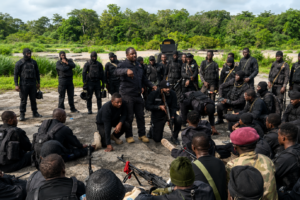
When news broke that the children abducted from the Oriire Community had been rescued, it brought a collective sigh of relief across the country. For their families, the nightmare had finally ended. For the security personnel involved, it was the successful conclusion of what must have been days of painstaking intelligence gathering, operational planning and immense personal risk.
But as the celebrations subside, perhaps the more important question is not simply how the children were rescued, but what the operation tells us about the future of security in Nigeria.
For years, insecurity was viewed through institutional silos, with successful operations judged by which agency deserved the credit. Yet criminals do not distinguish between the police, the military or intelligence services; they exploit gaps between agencies, making the growing culture of inter-agency collaboration one of the most encouraging developments in Nigeria’s security architecture.
The Oriire operation is another reminder that collaboration is no longer optional. Intelligence-led policing is strongest when backed by military capabilities, inter-agency coordination and community support. As recent joint operations have shown, insecurity has become too complex for any single agency to tackle alone.
Equally commendable was what happened after the operation. Both the Nigerian Army and the Nigeria Police Force honoured officers who distinguished themselves while paying tribute to colleagues who made the ultimate sacrifice. Such moments remind us that behind every successful operation are men and women who risk everything in service to the nation. A country that expects such sacrifice must never fail to honour it.
It was therefore disappointing, though perhaps not surprising, that almost immediately after the rescue, some voices chose to dismiss the entire incident as staged. Healthy scepticism has an important place in every democracy. Public institutions should never be immune from scrutiny. But there is a moral line that should not be crossed.
To casually dismiss the trauma endured by abducted children, the agony experienced by their parents, and the sacrifice of officers who lost their lives is to trivialise human suffering for the sake of political commentary. Not every national tragedy should become fodder for conspiracy theories. Some moments demand empathy before opinion. Regardless of political persuasion, Nigerians should be able to agree that the lives lost in the line of duty and the pain endured by victims deserve far greater respect than careless speculation.
Yet even as the country celebrates this successful rescue, we should resist the temptation to mistake recovery for victory. Every successful rescue is commendable, but it is also evidence that criminals were able to strike in the first place. The true measure of an effective security system is not how efficiently it responds after an attack but how consistently it prevents attacks from occurring.
That is where Nigeria’s security conversation must now evolve. Preventive policing, supported by technology and intelligence, offers the most sustainable pathway forward. Around the world, law enforcement agencies increasingly rely on artificial intelligence, predictive analytics, geospatial intelligence, drones, digital forensics and integrated surveillance systems to detect threats before they materialise. Criminal networks have embraced technology with remarkable speed. Security institutions cannot afford to fight twenty-first-century crime with nineteenth-century methods.
This thinking is beginning to find expression within the Nigeria Police Force. Speaking at the Fifth United Nations Chiefs of Police Summit in New York earlier this month, Inspector-General of Police Tunji Disu, observed that while technology presents enormous opportunities through artificial intelligence, digital forensics and geospatial intelligence, it can never replace public trust. He also noted that criminals now exploit AI, encrypted communications and cyber-enabled platforms, making innovation an operational necessity.
That perspective is significant because it recognises two realities at once. First, technology is no longer an accessory to policing; it is becoming its backbone. Second, technology without trust, accountability and collaboration cannot produce lasting security. Public confidence remains the currency upon which effective policing depends.
The implication is clear. Nigeria does not simply need more security personnel; it needs smarter security systems. It needs deeper intelligence sharing among agencies, stronger partnerships with local communities, greater investment in surveillance and forensic capabilities, and the political will to sustain collaboration long after the headlines disappear. The success of joint operations should become the rule rather than the exception.
The children from Oriire are home. That is a victory worth celebrating. But the greater national success will come when our investments in collaboration, intelligence and technology make such rescues increasingly unnecessary. In security, the highest achievement is not responding brilliantly after tragedy. It is preventing tragedy from happening at all.
…Lanre Olagunju wrote in from Abuja.

Police arrest officers in viral video threatening to slap, detain motorist if he’s Igbo
The Ondo State Police Command has confirmed the arrest of officers captured in a viral video attempting to extort money from a motorist along Lagos –Benin Expressway. In the video, one of the officers said he would have slapped and